


Enhanced Safety and Quality Control in Explosive Gases
Safety and quality control are paramount when handling explosive gases like biogas, hydrogen, and natural gas
One of the key parameters to monitor in these ga
ses is their oxygen content. Elevated oxygen levels in gas piping not only increase the risk of explosion or fire but can also trigger unwanted chemical reactions that compromise the quality and efficiency of the product. Accurate and consistent monitoring of the oxygen level, especially in high-pressure gas piping, is therefore essential for operational efficiency, product quality, and overall safety.
Traditionally, oxygen content was determined by extracting a gas sample and analyzing it under reduced pressure. This method, although tried and true, has its limitations. It introduces complexities due to sample conditioning and handling, and there’s also the inherent safety risk of extracting the sample.
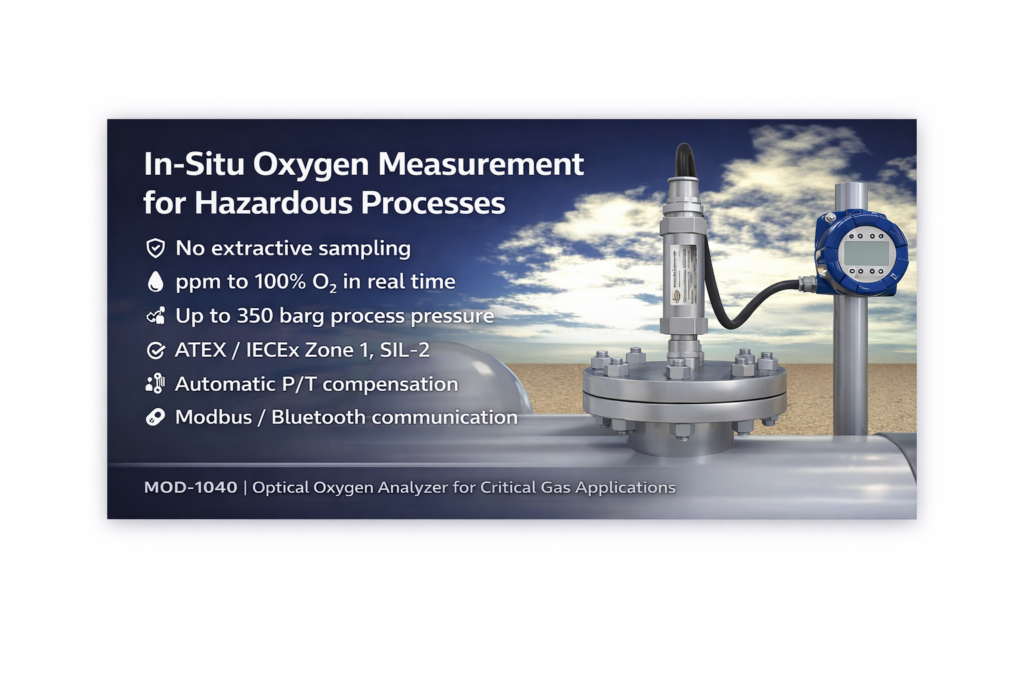
In response to these challenges, in-situ oxygen analyzers, which are installed directly inside high-pressure piping, have become increasingly popular. These analyzers offer the advantage of real-time measurements, thereby reducing complexity and enhancing accuracy.
Optical analyzers using fluorescence technology stand out in this category due to their several benefits. Fluorescence technology operates on a non-contact optical measurement principle. Here, a sample’s fluorescence emission is detected upon being excited by a specific light wavelength. Such optical oxygen analyzers can accurately measure high-pressure streams without needing any pressure reduction. They are also characterized by their high stability, accuracy, and simplicity in both installation and operation.
A notable mention in this category is the MOD-1040 Oxygen Analyzer. This innovative analyzer leverages cutting-edge photonics technology. It works on the principle of luminescence quenching of a unique sensor dye, which is immobilized on a support foil. The sensor spot is illuminated with red light, leading to luminescence that is subsequently measured in the near-infrared domain of the electromagnetic spectrum. The beauty of MOD-1040 is its capability to measure oxygen content directly in high-pressure pipelines, negating the requirement for gas sample extraction or conditioning.
For industries like hydrogen production, this means that oxygen can be monitored continuously in real-time without resorting to sample extraction or pressure modifications. This is a leap in operational efficiency and safety, as it curbs the risk of atmospheric oxygen exposure and diminishes the requirement for hazardous area classifications.
To sum up, for industries necessitating accurate and real-time oxygen measurements, especially in high-pressure gas pipelines, optical analyzers rooted in fluorescence technology are proving to be invaluable. With technological advancements and continued refinements in their designs, it’s anticipated that fluorescence-based analyzers like MOD-1040 will continue to dominate the realm of on-line oxygen analysis for many years to come.
