

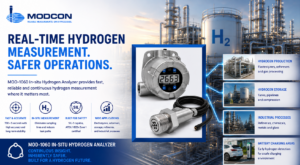
MOD-1060 Hydrogen Analyzer
The MOD-1060 provides continuous hydrogen measurement in industrial process gas at concentrations from low ppm levels up to 100% H₂, depending on the selected configuration and background-gas composition. It uses thermal conductivity measurement to deliver a rapid response for process monitoring, control and safety-related applications.
Contact us for more information
Designed for hydrogen production, refining, petrochemical and energy duties, the analyzer operates at process pressures from 0.8 to 200 bara and provides a T90 response below 30 milliseconds under specified test conditions. Its compact construction supports installation close to the measurement point, reducing the delay normally introduced by long sample lines.
Typical applications include hydrogen production, hydrogen-in-oxygen crossover measurement, refinery hydrogen networks, natural gas blending, fuel gas monitoring, chemical reactors, electrolysers and industrial gas production.
Range, accuracy and calibration depend on the background gas. Thermal conductivity provides rapid measurement but it is not selective to hydrogen alone. The complete gas matrix must be defined before performance is confirmed.
Key Capabilities
- Continuous real-time hydrogen measurement
- Measurement ranges extending up to 100% H₂
- T90 response below 30 milliseconds under specified test conditions
- Process pressure capability from 0.8 to 200 bara
- Thermal conductivity measurement without consumable reagents
- 4–20 mA output and RS-485 digital communication
- Integration with DCS, PLC, SCADA and plant monitoring systems
- ATEX and IECEx options for hazardous-area installation
- SIL 2 functional safety certification
- Compact configuration for installation close to the process
Technical Specification
Parameter | MOD-1060 capability |
Measured component | Molecular hydrogen, H₂ |
Measurement principle | Thermal conductivity measurement |
Measurement range | Up to 0–100% H₂, depending on configuration and background gas |
Response time | T90 below 30 milliseconds under specified test conditions |
Process pressure | 0.8 to 200 bara |
Operating temperature | −40°C to +90°C, with an option up to +125°C |
Specified accuracy | Below 50 ppm for the applicable configuration and stated operating conditions; confirm against approved datasheet |
Analog output | 4–20 mA |
Digital communication | RS-485 |
Power supply | 24 VDC ±25%, 5 W |
Process connection | ½-inch NPT |
Hazardous-area approvals | ATEX and IECEx options for Zone 1 II 2 G Ex db IIC T4/T3 Gb Tamb: -40°C to +90°C /+125°C |
Functional safety | SIL 2 according to IEC 61508-2:2010 |
Installation | Close-coupled or extractive arrangement, subject to process and mechanical requirements |
Operating principle
The MOD-1060 measures hydrogen using the difference between the thermal conductivity of hydrogen and that of the background gas. A controlled sensing element exchanges heat with the surrounding gas. Because hydrogen conducts heat considerably better than most industrial gases, a change in hydrogen concentration changes the rate of heat transfer from the sensor. The analyzer converts this response into a hydrogen concentration using calibration data prepared for the intended gas mixture and measurement range.
The principle provides very fast measurement and does not require chemical reagents. It is particularly effective in binary or well-defined gas mixtures where changes in thermal conductivity can be attributed mainly to hydrogen.
Measurement performance and gas-matrix effects
Thermal conductivity is not selective to hydrogen alone. Changes in oxygen, nitrogen, methane, carbon dioxide, water vapour or other components can influence the measured value. The complete gas composition must therefore be reviewed before the measurement range, calibration gas and expected accuracy are confirmed.
For hydrogen in oxygen, hydrogen in nitrogen and other substantially binary mixtures, the relationship between hydrogen concentration and thermal conductivity can be characterised accurately. More complex refinery, petrochemical and natural gas streams may require application-specific calibration, compensation or supporting composition data.
- Normal, minimum and maximum hydrogen concentration
- Full background-gas composition and expected variation
- Moisture content, dew point and condensation risk
- Process pressure and temperature
- Corrosive or reactive contaminants
- Required accuracy, alarm levels and response time
- Whether the value is used for control, quality monitoring or a safety function
- The published response time describes the analyzer under specified test conditions. The response of the complete installed system may also be affected by sample transport, process flow, filters, valves and internal volume.
Installation and process compatibility
The MOD-1060 can be installed close to the measurement point or incorporated into an extractive analyzer system. The correct arrangement depends on process pressure, temperature, gas cleanliness, maintenance access and hazardous-area classification.
Installation close to the process can reduce sample transport time and minimise the volume between the measurement point and the sensor. An extractive system may still be required where the process contains particulates, liquid carry-over, condensate or contaminants that must be removed before measurement.
Wetted materials, seals and the process connection must be selected for the complete process composition. Compatibility should be confirmed for hydrogen service and for any oxygen, moisture, H₂S, ammonia, hydrocarbons or other reactive components present in the stream.
A pressure rating alone does not establish process compatibility. Mechanical design, temperature, materials, connection rating and hazardous-area requirements must all agree with one another.
Applications
Hydrogen concentration can affect process safety, reaction performance, combustion behaviour, product quality and the use of hydrogen across a plant. The useful range and calibration depend on the duty, so application review matters more than a broad headline range.
Parameter | MOD-1060 capability |
Water electrolysis | Measures hydrogen in the oxygen product stream for crossover detection, purity monitoring and process protection. |
Refinery hydrogen networks | Monitors hydrogen in production, distribution, recycle and recovery systems. |
Hydrotreating and hydrocracking | Supports hydrogen availability, reactor operation and hydrogen-to-hydrocarbon ratio monitoring. |
Natural gas blending | Confirms hydrogen blending concentration and supports gas-quality control. |
Fuel gas systems | Tracks hydrogen variation that may affect calorific value, combustion behaviour and burner operation. |
Petrochemical processing | Monitors hydrogen in reactors, recycle streams and process gas. |
Chemical production | Maintains the required hydrogen concentration in reaction and synthesis processes. |
Power generation | Supports hydrogen monitoring in generator cooling and associated systems. |
Industrial gas production | Provides hydrogen concentration and product-quality measurement. |
Hydrogen storage and compression | Monitors gas composition during handling, transfer and storage. |
Hydrogen production and electrolysers
Water electrolysis produces hydrogen and oxygen in separate process streams. Membrane damage, pressure imbalance or other process disturbances can allow gas crossover. The MOD-1060 measures hydrogen in the oxygen stream, providing continuous indication of H₂-in-O₂ contamination for purity monitoring, early crossover detection and process protection.

 Where both crossover directions must be monitored, the MOD-1060 can be paired with the MOD-1040 Oxygen Analyzer to measure oxygen in the hydrogen stream. By delivering continuous real-time oxygen monitoring, the MOD-1060 and MOD-1040 helps operators improve efficiency, increase safety, and extend equipment life.
Refinery and petrochemical hydrogen networks
Hydrogen is used throughout refineries for hydrotreating, hydrocracking, reforming and product-quality improvement. Its concentration influences reaction performance, catalyst operation, hydrogen consumption and the capacity of the plant hydrogen network.
Continuous hydrogen measurement can support monitoring of hydrogen production, make-up gas, recycle gas, recovery units and refinery fuel gas. For multicomponent streams, the expected variation in hydrocarbons and other gases must be assessed because thermal-conductivity measurement responds to the complete gas matrix.
Hydrogen blending into natural gas
Hydrogen blending changes the physical and combustion properties of natural gas. It can affect calorific value, Wobbe Index, density, metering, burner performance and compatibility with downstream equipment.
The MOD-1060 can provide continuous hydrogen concentration data for blending control and verification. Measurement performance depends on how much the natural gas composition varies, so the complete operating envelope should be reviewed before the calibration strategy is selected.
Fuel gas and combustion applications
Variation in hydrogen concentration changes flame speed, energy density and combustion behaviour. The analyzer signal may be used alongside flow, pressure, oxygen and calorific-value measurements, depending on the burner system and control objective.
Certifications and compliance
The MOD-1060 is intended for hazardous-area and safety-related process applications. The website should reproduce the exact markings, certificate numbers, equipment variants and limitations from the current approved documents.
Parameter | MOD-1060 capability |
ATEX | Hazardous-area configurations; II 2 G Ex db IIC T4/T3 Gb; Tamb: -40°C to +90°C /+125°C |
IECEx | Hazardous-area configurations; Ex db IIC T4/T3 Gb |
Hazardous-area classification | Zone 1 and Zone 2, subject to the selected certified configuration |
Functional safety | SIL 2 according to IEC 61508-2:2010 |
SIL certificate reference | 020195:3544-1-P1 |
Process pressure | Up to 200 bara, subject to the approved mechanical configuration |
The exact Ex marking, temperature class, ambient-temperature range and process connection should be taken from the applicable certificate, nameplate and approved project documentation. Certification must not be inferred from a similar-looking enclosure or another product configuration.
Calibration, commissioning and maintenance
The analyzer should be calibrated using certified gas mixtures selected for the intended range and background gas. Calibration gas composition should reproduce the process matrix closely enough to avoid an unnecessary thermal-conductivity bias.
- Verify analyzer range and background-gas configuration
- Confirm process pressure, temperature and mechanical limits
- Leak-test process and sample connections
- Verify flow where an extractive arrangement is used
- Perform zero and span calibration using certified gases
- Confirm 4–20 mA and RS-485 signals
- Test alarms, interlocks and complete-loop response
Calibration frequency depends on the duty, required accuracy, operating history and quality procedures. Establish an initial interval during commissioning and refine it using recorded drift and verification results.
Plant integration
The MOD-1060 provides real-time hydrogen concentration data for plant control, monitoring and safety systems.
Parameter | MOD-1060 capability |
DCS and PLC | Continuous hydrogen value, alarms, process control and interlocks |
SCADA | Remote monitoring, trending and event review |
Safety instrumented system | Use subject to the certified SIL function, project safety requirements specification and final safety design |
4–20 mA | Continuous analog hydrogen measurement |
RS-485 | Digital measurement, device communication and system integration |
Modcon.AI and analytics | Use the validated hydrogen signal as one process input |