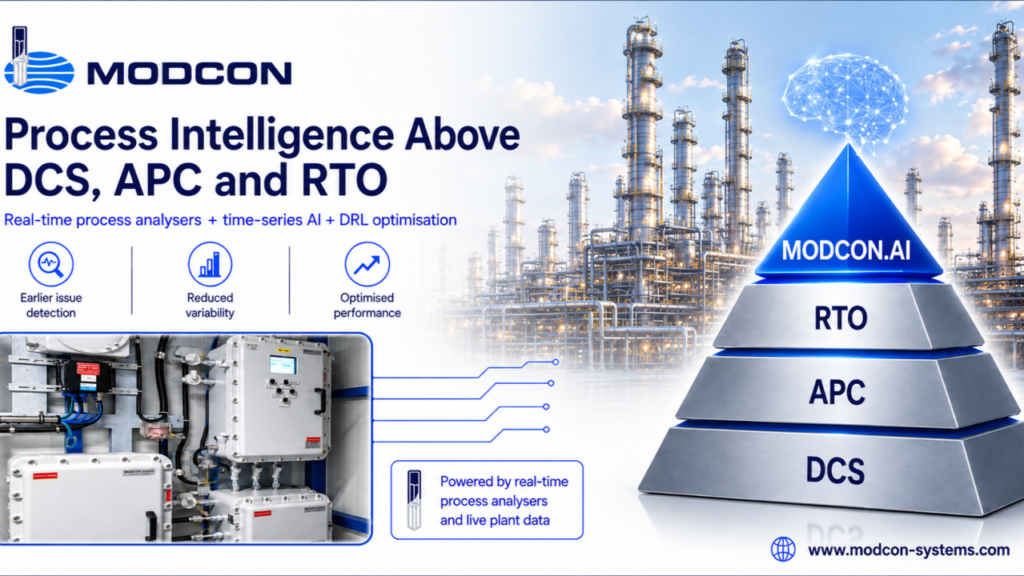


Modcon.AI: Process Intelligence Above DCS, APC and RTO
Why real-time process data is now the missing layer in industrial optimization
Modern process plants already have many control and optimization layers. The DCS controls the plant. APC reduces variability around known constraints. RTO calculates economic targets when the process is sufficiently stable. Historians store years of data. Alarm systems warn operators when limits are crossed.
Yet many industrial plants still lose efficiency, product quality and operating margin because the most important changes are detected too late.
The reason is simple enough. Most process disturbances do not begin as a single variable crossing a high or low alarm limit. They begin as a change in behavior. A reactor temperature profile becomes slightly unusual. A crude feed property moves before the lab result arrives. A hydrogen impurity trend starts to drift. A column profile no longer matches the expected separation behavior. Each individual measurement may still look acceptable, but the relationship between measurements has changed.
Modcon.AI is positioned above the traditional DCS, APC and RTO layers as an advanced process analysis and optimization environment. It uses modern time-series AI, multivariate anomaly detection and Deep Reinforcement Learning to learn how the plant behaves, identify early deviations and support better operating decisions.
The key point is that Modcon.AI is not another dashboard and not a replacement for the control system. It is an intelligent layer that works with existing plant infrastructure and depends on high-quality live process data. That is where process analyzers become essential.
The role of process analyzers in industrial AI
Industrial AI is only as useful as the data feeding it. A model trained on delayed, incomplete or unrepresentative data may still produce elegant calculations, but they may describe yesterday’s plant rather than today’s operation. Process analyzers close this gap.
Online process analyzers measure chemical composition, physical properties and product quality directly in the process or from a representative sample stream. They provide the live information that normal instrumentation cannot fully capture. Flow, pressure and temperature are important, but they rarely explain the whole process. In many cases, the real economic and safety questions are compositional:
- What is the crude quality entering the CDU?
- Has the blend shifted?
- Is oxygen present where it should not be?
- Is hydrogen purity stable?
- Is the Wobbe Index changing?
- Is the product moving towards an off-spec condition?
- Is the reactor behaving normally for this feed, product and operating mode?
Modcon’s process analyzer portfolio is designed to provide this type of real-time process information across gas, liquid, crude oil, refining, hydrogen, petrochemical and energy applications. The company describes process analyzers as systems used to determine chemical composition or physical properties of substances in industrial processes, supporting efficient and accurate analysis for process optimization.
Why DCS, APC and RTO need an intelligent layer above them
DCS, APC and RTO remain important. The DCS is the operational backbone. APC helps stabilize complex multivariable processes. RTO supports economic optimization. None of these should be casually bypassed or replaced.
The issue is that these systems were largely built around known models, fixed constraints, established operating envelopes and structured control strategies. They work well when the process behaves within expected limits. They are less effective when feedstock quality changes quickly, product campaigns vary, equipment condition drifts or nonlinear process interactions become more important than single-tag limits. This is now common in many process industries.
Refineries must handle more variable crude sources, opportunity crudes, tighter product specifications and stronger pressure to reduce energy consumption. Hydrogen and industrial gas plants need faster quality control and higher safety confidence. Petrochemical and chemical plants operate with more grade changes, batch combinations and changing catalyst or reactor behavior. Operators are asked to run closer to constraints, but with fewer surprises. A fine ambition, provided the plant agrees.
Modcon.AI is designed to support this environment by adding adaptive process intelligence above the traditional automation stack. It continuously analyses live plant data, learns relationships between variables and identifies when the process begins to move away from expected behavior.
From fixed alarms to multivariate process health
Traditional alarm systems are normally based on fixed limits. A pressure is high. A temperature is low. A flow is outside range. This approach is necessary for basic protection, but it is not enough for early process health analysis.
Process problems often start before alarms. They appear as changes in relationships between variables. A pressure trend may be acceptable on its own, but unusual when compared with flow, temperature and composition. A reactor temperature may remain within limit, but its profile may no longer match the normal behavior for that product and batch phase. A crude distillation column may remain stable, but energy use, cut point behavior and product properties may quietly move in the wrong direction.
Modcon.AI Process Health Analysis is based on learning what normal process behavior looks like. It uses data-driven or hybrid models to learn relationships between process parameters, then monitors live performance for deviations from expected behavior. This allows early detection of faults, equipment deterioration, quality issues and process inefficiencies before they create larger operational problems.
This is the practical value of multivariate anomaly detection. It does not only ask whether one tag is high or low. It asks whether the group of variables still makes sense together. That is a much better question.
More signal, less noise
Operators do not need more alarms. Most plants already have enough alarms to decorate a Christmas tree. What operators need is earlier and more meaningful information. Multivariate anomaly detection helps by surfacing abnormal patterns before they become alarm storms. This matters because alarm storms rarely give operators time to think. Once the alarm flood begins, the team must determine which alarms are causes, which are effects and which are just noise from the process shouting at the screen.
Multivariate anomalies often precede alarm storms. If detected early enough, they provide operators with a useful cushion: time to reduce feed, adjust a setpoint, verify process analyzer readings, change cooling, stabilize a reactor or prevent a disturbance from becoming an incident.
Modcon.AI is designed to surface these early behavioral deviations. Instead of waiting for fixed alarm limits, it learns expected behavior across operating modes and identifies when the process begins to drift. This is particularly important in safety-related and high-value operations, where a few minutes can make the difference between a controlled correction and an unplanned shutdown.
Dynamic limits for reactors, batches and changing products
Fixed alarm limits are simple, but plants are not simple. A reactor running one product at one load may have a completely different normal profile from the same reactor running another product at another load. Batch processes are even more demanding because each batch phase has its own expected trajectory. The profile shape often matters more than the absolute value of a single measurement.
Modcon.AI dynamic limits are intended to model this kind of behavior in real time. The system continuously learns plant behavior across multiple reactors, products and batch combinations. It then surfaces subtle deviations that may not be visible through conventional static limits.
In one application, Modcon.AI dynamic modelling of reactor profiles helped the plant reduce disc ruptures by more than 15% and achieve a 10% reduction in reaction and process variability. The important lesson is not only the reduction itself. It is that the system identified weak signals before they became obvious process problems.
Modcon.AI uses time-series process data from analyzers, instrumentation, control systems and historians to understand how the plant behaves over time. Modcon’s AI/ML solutions are described as combining information from online analyzers, process instrumentation, laboratory systems and control platforms to identify patterns difficult for operators to detect manually. The objective is better stability, product quality, energy performance and earlier detection of process deviations.
DRL-based optimization above the control layer
Deep Reinforcement Learning is one of the more powerful technologies used in modern process optimization, but it must be applied with engineering discipline.
A live process plant is not a playground for uncontrolled algorithmic experiments. DRL must operate within defined safety, process and operational constraints. It must respect the existing DCS, APC and protection layers. It should support better decisions, not behave like a clever intern with root access.
In a Modcon.AI architecture, DRL can be used as a higher-level optimization method. It learns how process states, actions and outcomes are connected. It can evaluate which operating strategies improve yield, reduce energy consumption, stabilize product quality or reduce process variability.
This is especially valuable in nonlinear, multivariable processes where conventional fixed models struggle or require frequent manual updates. Examples include crude distillation, fuel blending, reactor optimization, gas quality control, hydrogen production and energy-intensive separation processes.
The important point is that DRL becomes much more practical when it is grounded in live analyzer data. Real-time composition and property measurements allow the AI model to compare expected behavior with the actual process condition. Without this link, optimization can become too dependent on assumptions, historical averages or delayed laboratory confirmation.
CDU optimization: live crude quality changes the problem
Crude distillation is one of the clearest examples of why live analyzer data matters. A crude distillation unit is strongly affected by crude density, viscosity, sulphur content, boiling behavior and component separability. These properties influence furnace duty, column temperature profiles, cut points, pumparound performance, stripping efficiency and product quality.
Traditional CDU optimization often depends on simulation models, crude assays, delayed laboratory results and steady-state assumptions. These tools are useful, but they cannot fully solve real-time crude variability. During crude switching, tank changes or feed disturbances, the CDU needs to know what is actually entering the unit now.
The MODCON.AI CDU Optimization Suite combines AI, Deep Reinforcement Learning and real-time crude oil analysis to identify optimal CDU operating setpoints. It is designed to improve yield, reduce energy consumption, maintain product quality and lower operating costs. Unlike conventional tools that rely heavily on fixed models or delayed laboratory data, the suite adapts to changing crude properties in real time.
The role of the process analyzer is central. The MODCON.AI CDU Optimization Suite uses real-time crude quality data from the MODCON 4100 Crude Oil NIR Analyzer. This online analyzer provides live measurements of crude oil composition, viscosity and other important properties that affect distillation performance.
This creates a practical closed loop:
- The analyzer measures actual crude quality.
- The AI model interprets how the CDU should respond.
- The optimization layer identifies improved operating setpoints.
- The existing control system applies approved actions within plant constraints.
This is not theory dressed in a hard hat. It is the practical route to making CDU optimization responsive to real crude variability.
Process health analysis and predictive maintenance
Process health analysis is also important outside direct optimization. Many faults begin as small deviations from normal behavior. Equipment deterioration, fouling, catalyst ageing, analyzer drift, heat exchanger losses and control valve problems can all appear first as subtle changes in process relationships.
Modcon.AI Process Health Analysis establishes normal behavior through data-driven or hybrid models. It then continuously monitors real-time performance and identifies deviations that may indicate potential faults or equipment deterioration. This supports early corrective action, improved product consistency and predictive maintenance based on live process data rather than fixed intervals alone.
This is a strong fit for plants where unplanned downtime is expensive and minor inefficiencies accumulate quietly. By detecting process health markers early, operators and maintenance teams can decide whether to adjust operating parameters, inspect equipment, schedule cleaning or investigate a developing fault. The benefit is not only fewer failures. It is fewer surprises.
Process analyzers as the industrial AI anchor
The more advanced the AI layer becomes, the more important the measurement layer becomes.
A good AI system can detect patterns in large volumes of data. A poor measurement system can feed it nonsense at impressive speed. Industrial optimization therefore depends on representative, reliable and timely process measurements.
Modcon’s process analyzer systems are designed around this principle. Complete analyzer systems may include analyzer houses, power distribution, gas and flame detection, piping, wiring, process sample probes, transport lines, sample conditioning, stream selection and recovery systems. Modcon highlights the importance of representative and rapid sampling while avoiding contamination and dead volume.
This is not a minor engineering detail. A sample delay, contaminated sample, poor probe location or unsuitable conditioning system can damage the value of the entire optimization layer. If the analyzer does not represent the real process, the AI model will optimize a fiction.
For this reason, Modcon.AI and Modcon process analyzers should be viewed as connected technologies. The analyzers provide live, process-relevant truth. Modcon.AI converts that truth into earlier detection, better understanding and improved operating decisions.
A layered architecture for modern plants
A practical industrial AI architecture should not fight the existing automation structure. It should strengthen it.
A typical layered approach can be described as follows:
- The DCS provides basic control, interlocks, operator interface and safe operation.
- APC manages multivariable control and reduces variability around defined constraints.
- RTO supports economic optimisation, often using plant models and planning objectives.
- Process analyzers provide live composition, physical property and quality measurements.
Modcon.AI sits above these layers, learning process behavior, detecting multivariate anomalies, modelling dynamic limits and supporting DRL-based optimization.
This structure allows AI to add value without pretending that established control systems are obsolete. They are not. They simply need better live intelligence above them.
From delayed reaction to early intervention
The main value of Modcon.AI is the shift from delayed reaction to early intervention.
- Instead of waiting for laboratory confirmation, the plant can use live analyser data.
- Instead of waiting for alarms, the plant can detect abnormal multivariate behaviour.
- Instead of relying only on fixed models, the plant can use AI models that learn and adapt.
- Instead of treating process variability as unavoidable, the plant can identify where it starts and act earlier.
This is particularly important in plants running closer to economic, safety or environmental constraints. The operating margin is often hidden in the minutes before the alarm, the composition change before the lab result and the deviation before the shutdown.
Conclusion
The next generation of process optimization will not be driven by AI alone. It will be driven by the combination of AI and trusted real-time process analysis.
Modcon.AI brings time-series AI, multivariate anomaly detection, dynamic limits and DRL-based optimization into a layer above DCS, APC and RTO. Modcon process analyzers provide the live composition and property data needed to make that layer useful, practical and grounded in the real plant.
This combination addresses one of the central problems in modern industry: the need to operate more flexibly, safely and efficiently while processes become more variable and less forgiving. When minutes matter, the plant does not need another after-the-event report. It needs reliable measurements, early detection and intelligent optimization while there is still time to act. That is the role of Modcon.AI.