


The Rise of NIR-Based Technologies
In the ever-evolving landscape of petroleum refining, optimizing production while maintaining cost efficiency has always been a paramount challenge. The modern refinery is a high-volume, low-margin enterprise where feedstock costs often account for up to 90% of cash flow. Therefore, refineries must focus on reducing feedstock expenses, minimizing operating costs, and maximizing product revenue. Advanced process analyzers, especially those employing near-infrared (NIR) spectroscopy, have become integral to refining operations, driving a new era of optimization and efficiency. The evolution of these technologies has significantly enhanced the real-time measurement capabilities within refineries, enabling refiners to achieve higher conversion rates, improved feedstock flexibility, and increased margins while meeting stringent environmental and product quality requirements.
The Role of Process Analyzers in Refinery Optimization
Process optimization is critical to ensuring that refineries produce high-value, on-specification products at minimal operational costs and environmental impact. Real-time analytical feedback, which advanced analyzers provide, allows for immediate adjustments in process conditions to maintain optimal production. Traditional laboratory analyses, while accurate, are too slow to offer real-time feedback, which is vital in the dynamic refinery environment. In contrast, on-line analyzers provide continuous, real-time data that is crucial for adjusting processes to meet production targets and regulatory compliance.
Historically, process analyzers have been categorized into two primary types: ASTM-based analyzers and correlative analyzers. ASTM-based analyzers offer high accuracy and are less dependent on feedstock quality variations, but their response time is longer, and maintenance costs can be prohibitive. Correlative methods, such as those based on NIR spectroscopy, provide faster results with lower maintenance costs. However, these analyzers require validation against standard laboratory methods to ensure their accuracy, typically following ASTM procedures. The challenge for modern refineries lies in balancing the precision of ASTM-based methods with the speed and cost-effectiveness of correlative technologies.
Advances in NIR Technology
NIR spectroscopy has emerged as a leading technology in process analysis, especially in the context of petroleum refining. NIR-based analyzers, like the Beacon 3000 and MOD-4140, offer numerous benefits over traditional process analyzers. These include faster analysis times, higher multiplexing capabilities, and reduced maintenance requirements. These analyzers provides real-time hydrocarbon analysis with detection times as short as 30 seconds. Their accuracy and repeatability are correlative to ASTM laboratory methods, ensuring that refiners can rely on NIR analyzers for critical decision-making.
The Beacon 3000 NIR analyzer represents a significant advancement in this field. By measuring the absorption spectrum in the near-infrared region, the Beacon 3000 offers fast and accurate analysis of petroleum, chemical, and petrochemical products without the labor and material waste associated with traditional methods. This technology enables refiners to monitor up to eight flow cells in parallel, providing a cost-effective and efficient solution for process control. One of the key advantages of the Beacon 3000 is its ability to integrate seamlessly into refinery control systems, allowing for tighter process control and early identification of process deviations. This capability ensures that refiners can make real-time adjustments to maintain optimal production efficiency and product quality. Additionally, the Beacon 3000’s unique architecture, which separates the main analyzer from field units via telecommunications fiber optics, allows for flexible installation in challenging environments. With field units that are free of electricity and moving parts, the system is both explosion-proof and highly reliable in hazardous areas.
The MOD-4140 NIR analyzer is distinguished by its high spectral measuring range and exceptional light intensity, which allows it to measure not only transparent but also opaque petroleum products such as crude oil. This is a significant advantage in refinery operations, where crude oil’s complex composition and varying opacity often pose challenges for traditional analyzers. The advanced optical design of the MOD-4140 enables it to penetrate through denser and more opaque fluids, providing accurate, real-time analysis of hydrocarbons even in the most challenging conditions. This capability extends the utility of the MOD-4140 to crude oil monitoring, offering refineries a powerful tool for optimizing the processing of feedstocks from initial distillation to final blending. By ensuring precise measurements in opaque products, the MOD-4140 supports enhanced process control and greater flexibility in feedstock selection, further contributing to increased refinery margins and operational efficiency.
Chemometrics in Modern On-line Analysis
Central to this debate is the interdisciplinary field of chemometrics, which fuses mathematical and statistical methodologies to extract valuable information from chemical datasets. Essentially, chemometrics employs mathematical models to unravel complex chemical datasets, illuminating hidden patterns or relationships. In the industrial context, the vastness and complexity of chemical data necessitate tools like chemometrics to distill actionable insights.
Software platforms like Unscrambler X, SIMCA, and Minitab have been pivotal in facilitating chemometric analyses. While powerful, these platforms often demand a robust understanding of both the intricacies of chemometrics and the software mechanics—a steep learning curve that can deter many from adopting them.
The intertwining of machine learning (ML) technologies with chemometrics has emerged as a beacon of hope. Machine learning, with its innate capability to discern patterns from colossal datasets without explicit programming, complements chemometrics, especially when grappling with extensive, multifaceted data.
Benefits of merging ML into chemometrics include:
- Efficiency and Simplicity: Automation minimizes manual interventions and their associated errors.
- Scalability: ML models effortlessly scale with growing datasets.
- Adaptability: These models adapt to evolving data patterns, ensuring enduring relevance.
ASTM-based process analyzers have gained traction for quality control, but they entail significant investments. Correlative analyzers operate differently. They do not measure chemical or physical properties according to well-defined procedures, but use mathematics and algorithms to correlate between the spectrum and different physical properties of a chemical composition. This relates to the effect that overall physical properties and the spectral pattern are the result of the contribution of each individual compound that is present in a chemical composition in a process stream.
A significant hurdle for industries is the depth of expertise required to craft mathematical models. Integrating ML into the chemometric landscape offers a solution. Modern ML-driven platforms are designed for intuitiveness, eliminating the need for profound knowledge in either domain. Users simply input data, and the software orchestrates the rest, producing precise and interpretable models.

Figure 1: Initial data screening
The secret to harnessing their full potential lies in a diligent approach to modeling, especially considering the opacity constraints of certain liquids. The spectral outcomes, influenced by the variable composition of crude oil and especially by hetero-atomic molecules, necessitate strategies for mitigation.
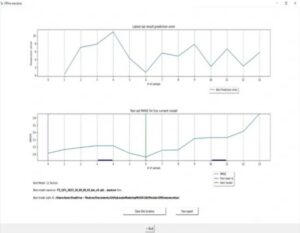
Figure 2: Offline execution
A significant hurdle for industries is the depth of expertise required to craft mathematical models. Integrating ML into the chemometric landscape offers a solution. Modern ML-driven platforms are designed for intuitiveness, eliminating the need for profound knowledge in either domain. Users simply input data, and the software orchestrates the rest, producing precise and interpretable models.
Real-Time Feedback for Process Intensification
One of the most significant contributions of NIR-based process analyzers is their ability to provide real-time analytical feedback on process changes. Whether refineries are adjusting to fluctuations in crude oil properties or optimizing the performance of catalytic processes, NIR analyzers ensure that operational changes are immediately reflected in the quality and composition of refinery products. This real-time feedback loop is essential for maintaining the highest possible production capacities while minimizing energy consumption and reducing environmental impacts.
The MOD-4140, for example, is specifically designed to monitor hydrocarbons in real-time, offering high-resolution spectral data that helps refineries optimize their operations. Its robust design allows it to withstand extreme operating conditions, including high temperatures and pressures, making it suitable for the demanding environments typical of modern refineries. The analyzer’s advanced communication capabilities, including Modbus over TCP/IP, ensure seamless integration with existing control systems, further enhancing its value as a tool for process intensification.
Conclusion
As the petroleum industry continues to evolve, the role of advanced process analyzers, particularly those based on NIR technology, will become increasingly critical. These analyzers provide the real-time data necessary for optimizing refinery operations, reducing feedstock costs, and improving product quality. With innovations like the Beacon 3000 and MOD-4140, refineries can now achieve higher levels of efficiency and profitability while minimizing environmental impacts and operational risks. The future of petroleum refining lies in the continued advancement of process analyzers, where NIR spectroscopy will undoubtedly play a leading role in driving process optimization and economic success.
