

Why Fuel Blending Matters More Now Than It Did Ten Years Ago
Ten or fifteen years ago many refineries could still work with a relatively stable view of component quality, product demand and operating mode. Today that cushion is thinner. Feedstocks move more often. Finished product specifications remain tight. Blend components are under greater economic pressure. Renewable and alternative streams add complexity rather than comfort. Margin is watched more closely and quality giveaway is harder to shrug off as the cost of staying safe. In that setting, fuel blending is no longer just a routine finishing operation. It has become one of the places where process understanding, commercial discipline and plant flexibility meet directly.
That deserves more attention than it sometimes gets. Blending is still too often described as if it were mostly a recipe problem. It is not. It is a live plant problem. It involves moving stream properties, non-linear interactions, limited inventories, delayed laboratory truth and the awkward fact that by the time a blend looks wrong in a tank, the money has already gone.
A mature field that is still moving
Fuel blending is a mature industrial discipline. That is precisely why new technical progress in this field matters. Mature fields do not produce meaningful new methods unless there is still a gap between how the process is supposed to behave and how it behaves in live operation.
That is part of the significance of Modcon’s recently published fuel blending patent. The point is not that blending itself is new. It obviously is not. The point is that there is still room for useful engineering work at the interface between on-line process analyzers, optimization and plant-wide control. When a new patented method appears in a field as established as in-line blending, it usually says something simple: the hard bits have not been solved by routine practice.
The wider technical message is worth noting. Better blending is not just about calculating the cheapest combination of available components. It is about keeping the final product on target while the real plant keeps changing. A blending system that cannot see those changes quickly enough will either drift into off-spec production or fall back on conservative operation with needless giveaway. Neither outcome is attractive.
Blending is no longer just about following a recipe
A conventional view of blending starts with planning. A target grade is defined. Available components are assessed. A recipe is produced. Operators or the DCS apply the ratio and the blend is made. That logic still has a place, but it is not enough once component quality begins to shift in real time.
Each blending component brings more than volume. It brings a set of physical and chemical effects that do not always combine in a tidy linear fashion. In gasoline blending, octane value, vapor pressure, density, distillation behavior, aromatics, benzene and oxygenate effects all influence the outcome. In diesel and heavier fuels the relevant property set changes, but the basic problem does not. The finished blend is shaped by interaction, not only by addition.
That means fuel blending is better understood as a constrained optimization and control problem. The refinery is not simply deciding what product it wants. It is deciding how to keep producing that product within specification and at minimum cost while the quality of incoming streams, upstream unit behavior and commercial priorities are all moving at once.
Why online analysis has become essential
This is where online analysis stops being a nice extra and becomes part of the operating core.
The basic problem is timing. Laboratory data may be accurate, but it arrives after the process has already moved on. That is acceptable for validation. It is much less useful for immediate control. By the time a delayed result confirms that the product has drifted away from target, the refinery may already be dealing with reblending, giveaway, downgraded material or a tank that cannot be released.
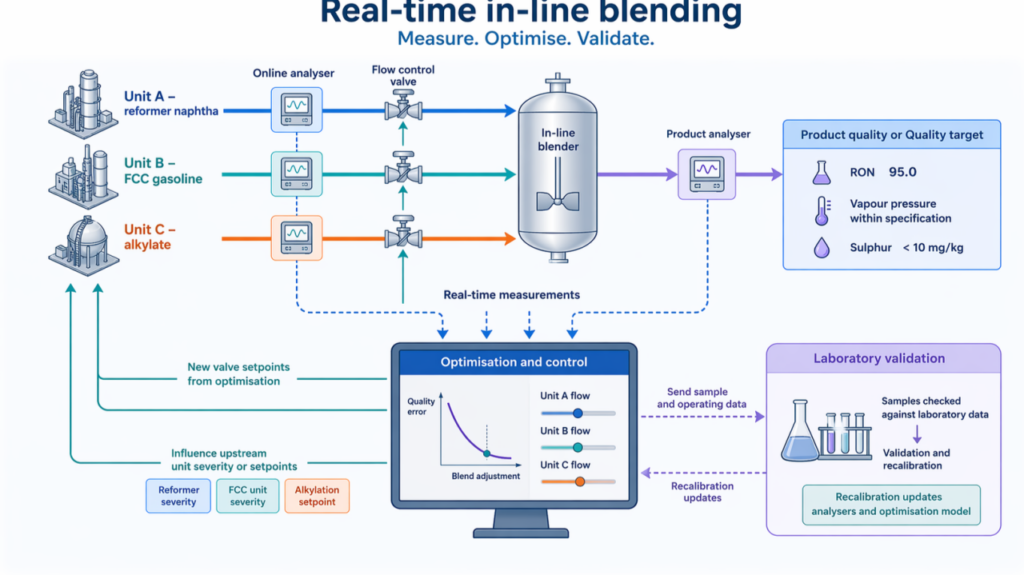
In-line blending does not leave much room for that sort of delay. The whole value of in-line blending lies in continuous and simultaneous delivery of several components in the correct ratio through a static mixer so that the finished product is produced directly and continuously. To operate that way properly, the system must know what is actually happening in the component streams and in the final blend while the blend is being made. That is why online process analyzers matter so much.
Online analysis performs several jobs at once.
First, it gives direct visibility of relevant quality properties in the incoming streams. That matters because the blend is only as predictable as the streams entering it. If a component has drifted in octane, density, sulphur, vapor pressure or some other controlling property, then a recipe based on old values becomes less useful than it looks on paper.
Second, it provides real-time visibility of the blend itself. That means the blending system is not operating blind between laboratory samples. It can compare the actual blend against target values while the blend is still being formed and can correct before the deviation grows into a tank-scale problem.
Third, online analysis makes real optimization possible rather than merely theoretical optimization. Simulation tools and LP-based blending models remain valuable, but they rely on the quality of the data behind them. When feed properties fluctuate, the model needs to be updated continuously with current analytical information. Otherwise the optimizer is not optimizing the real blend. It is optimizing yesterday’s memory of the blend.
That is one of the most practical reasons online analysis matters more today. The process is dynamic. The model therefore has to be dynamic too.
The usual weak point in blending systems
Many blending projects do not struggle because the software is poor. They struggle because the data feeding the software is stale, incomplete or not representative.
A planner may generate a feasible blend. A controller may hold the commanded ratios beautifully. The whole arrangement can still miss the target if the assumed component quality is wrong. It is an oddly elegant way to fail.
This is why online analysis should not be seen only as a measurement add-on. It is part of the control architecture. It closes the gap between what the system assumes and what the process is actually doing. Without that feedback, ratio control alone can only preserve a mistake more accurately.
There is another issue as well. Fast analytical methods are valuable, but they must remain believable. Correlative analyzers such as Process NIR Analyzer can provide rapid multi-property information and are often very effective in transparent or lighter streams. ASTM-based online analyzers remain relevant where the property or stream demands a different approach. In both cases, the key point is not simply speed. It is the combination of speed, representativeness and validation. A fast analyzer that is drifting quietly out of calibration is not helping the blend. It is helping the error travel faster.
A serious blending system therefore needs both live measurement and disciplined validation. It needs to compare online values with trusted references and correct the analytical model when persistent deviation appears. Otherwise the optimizer ends up adjusting the plant around a false signal. Plants do not usually thank you for that.
Why the new Modcon patent is relevant
This is where the recently published Modcon patent becomes technically interesting.
Its importance is not that it restates the general idea of blending. Its importance is that it treats blending as an integrated live process in which measurement, comparison, prediction and control adjustment are linked together. That is a more realistic view of the problem.
In practical terms, the patented method reflects a simple but often neglected truth: blending performance depends on more than selecting a ratio once and hoping the streams behave. It depends on analyzing the streams, comparing the actual blended result against the intended quality, predicting what needs to change and adjusting the process repeatedly until the blend sits where it should. That is the logic of a closed loop rather than a recipe handover.
The patent is also relevant because it looks beyond the final blend header. In real refinery operation, the blend is not born at the mixer. It is prepared upstream. Reforming severity, FCC behavior, hydrotreating conditions, tankage constraints and other process settings all influence the quality and value of the streams arriving for blending. If the blending system is isolated from the wider production chain, its ability to optimize is limited from the start.
That broader systems view is increasingly important now. The more variable the feedstock slate and product requirements become, the less useful it is to pretend that blending can be optimized as a narrow downstream task.
The pressure from today’s operating reality
The reason blending matters more now is not only technical. It is commercial and operational at the same time.
A refinery processing variable crudes or managing frequent changes in component availability cannot afford to wait for slow correction. A blender working with renewable or oxygenated components cannot rely entirely on fixed historical assumptions. A fuels producer facing tight margin and strict quality windows cannot treat giveaway as harmless insurance. In each case the same conclusion appears from a different direction: the blend must be understood while it is happening.
This is especially true in high-throughput continuous operation. In-line blending is attractive because it avoids the delays and tank occupancy associated with in-tank blending. It provides immediate production, better use of storage and faster response to changes in production planning. But those advantages only hold if the quality control side keeps up. Otherwise the plant has simply moved the risk from the tank to the line.
What effective blending now looks like
Effective fuel blending today is not static and it is not blind. It starts with reliable online measurement of the component streams and the finished blend. It uses those measurements to update the simulation or optimization model continuously. It compares actual blend quality with target quality while the blend is still being produced. It allows control action to follow current data rather than fixed assumptions. It validates the analytical layer so that speed does not come at the expense of trust. And it recognises that upstream unit behavior is part of the blending problem, not something conveniently outside the fence.
That is the real direction of progress. Not louder software. Not grander dashboards. Better linkage between the plant, the analyzers, the model and the control action.
A simple conclusion
Fuel blending has become more important because the refinery has become less forgiving.
More variability in feeds. More pressure on margin. Less tolerance for giveaway. More complicated blend pools. Higher expectations for continuous optimization. All of that lands at the blending operation sooner or later.
The practical response is equally clear. In-line blending needs live visibility. It needs online analysis not as an optional accessory but as one of the things that makes efficient control possible. And it needs optimization methods that follow the real process rather than a polite fiction of the process.
That is why fuel blending still deserves engineering attention in a mature industry. It is not old news. It is one of the places where real-time process understanding still decides whether the plant is merely running or running well.