

Remote Fever Screening for Workers Protection
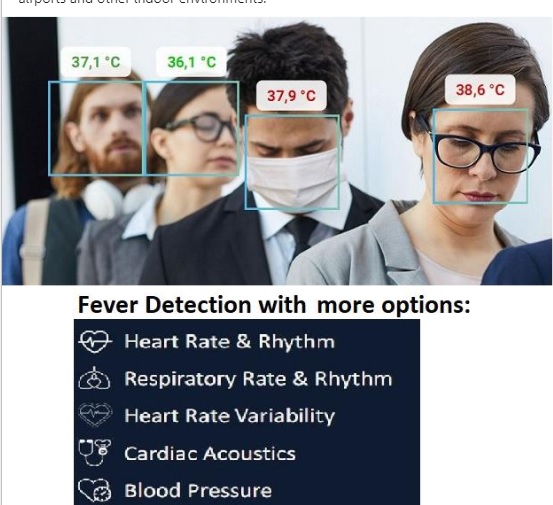
The oil and gas industry is facing a downturn exacerbated by the Covid-19 pandemic, but companies are introducing new protocols to keep workers safe. Our latest remote screening system simultaneously measures the body temperature of up to 5 people by scanning people’s faces. Optional body screening is additionally performed to detect physiological parameters and biomarkers associated with cardiac and respiratory conditions, including pneumonia-like symptoms, such as those demonstrated in persons infected and fighting COVID-19. Remote sensing solution enables the most accurate and fastest screening of persons at the marketplaces, industrial facilities, offices, public transport, hospitals, stadiums, airports and other indoor environments.

In practice, remote fever screening for workers protection is about getting dependable information from the plant when operators need it. In continuous industries, laboratory data remains important, but it represents a sample taken at a particular moment. Online analysers add a different capability: they show how the process is changing between laboratory samples and provide the frequency of information needed for control, optimisation and early detection of abnormal conditions.
In process analysis, the analyser specification is only part of the job. Reliable results also depend on how the measurement is installed and operated. That means checking sample representativeness, pressure and temperature, phase behaviour, stream composition, response time, hazardous-area requirements, calibration method and integration with the plant DCS or control system. Even a good analyser can give misleading results when the sample arrives late, changes phase or is conditioned in a way that alters the property being measured.
Our engineering work brings together online process measurement, automation, process safety and industrial optimisation around the actual process objective. The right arrangement may use direct in-situ measurement, an engineered sample conditioning system, optical or thermal-conductivity sensing, NIR analysis, or integration of several measurements into a wider optimisation strategy. Live analyser data can also improve the quality of information available to APC, digital twins and industrial AI by giving these systems current composition and quality data instead of relying only on inferred values.
For remote fever screening for workers protection, the final configuration should be checked against the project datasheet and the full operating envelope. The aim is straightforward: a measurement that works under real plant conditions, can be maintained without drama and gives operators information they can use.
Modcon Systems Ltd. develops and integrates process analysis solutions for demanding industrial applications.
This article considers Fever Protection as part of the wider discussion on remote fever screening for workers protection, with emphasis on practical process-industry applications and operating requirements.
